Monday, 15 November 2010

White Wedding

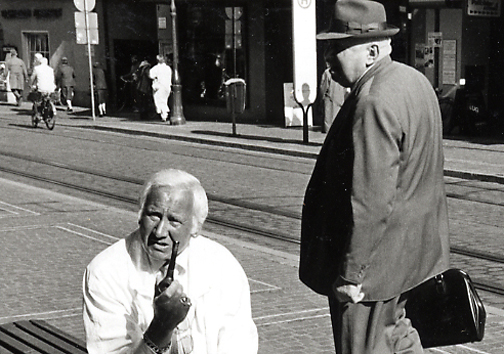
Tired of queuing for my own hackneyed (over-eyed?) concept I take to the streets of Freiburg in search of a virgin-image, The Woman in White. I want her to marry a ‘dead man’.
He must be dead by now, the old white-haired, white-suited, white-socked, white-shoed, darkly suntanned (Ronsealed?) pipe-puffer I snapped on these very same streets, back in 1985.
A joining of two parts – kinship; ‘With this camera, I now pronounce you…’ To preside over this mirage of a marriage (the word mirage comes from the Latin mirare, meaning “to look at, to wonder at”) like The Priest of Lightness... or The Priest of Likeness, even. 

Sunday, 14 November 2010

Queuing For My Own Concept

I attempt to repeat my ‘Time-Stands Still’ concept (see last blog) – my experiment of a quarter of a century ago: to take a photograph of a two-timing, pipe-puffing, three-faced, carving of a clock-bearer, twice a day, for a week, at the exact times indicated by three stopped-clocks he’s peddling. Day One. I turn up to take a photograph at 10.04 am, but there’s a queue. 
Put out, I’m back at 2.35 (a deliberate miss-reading of 7.11, but I couldn’t stand the wait), only to find myself in a queue again. I found myself in the strange position of having to queue for my own concept. Horrible, when the world and his wife gets the same idea as you, and you find yourself having to queue to view what you already knew.

Thursday, 11 November 2010

Clockwork

I go from one umbrella, to another, swap three pizza boxes and three signs, for three clocks showing two different times: in no time at all I’m down amongst the cobbled streets of Teutonic Freiburg, where time has stood still.
A quarter of a century ago I photographed (clocked) this pipe-smoking Mr. Time, twice a day, for a week. I’d be there just after ten in the morning, and be back again just after seven in the evening, to take a photograph (he also carries another three clocks on the other side of his back, showing three different times again when viewed from the right, but I chose to ignore these times - I would have been coming and going all day!). Time dictated the images. This is important because at that time I wouldn’t have been seen dead photographing wing-mirrors: photographs of reflections in car wing-mirrors are clichés. 
But one sunny morning in April 1985, at four minutes past ten, a wing-mirror shadow screamed, ‘pipe’. Looking at it now, I see the wing-mirror as a fourth clock – a sundial, a sun-scream to the pipe-scream. And Mr. Time, he could do with a coat of the varnish – the wood equivalent of sun cream. And doesn't a parasol cast the same shadow as an umbrella? 

Monday, 8 November 2010

Oral 1 (3 by 3)

Last summer found me back on the Schlossberg again, for the first time in twenty-five years. Nowadays a safety rail protects against potential picture-postcard suicides. The view over Freiburg and the Rhine valley - and beyond, the faint blue outline of the Vogues in Alsace, France - is still as pretty as a picture, still, a postcard view.
I run my hand along the safety rail as I follow the wall around the perimeter of the beauty spot until it turns inland, coming to an abrupt end at a ball and a bin. The mouth of the bin is stuffed with pizza cartons: spewing them out or taking them in? Tattooed across the bin’s forehead, Oral 1. A deranged umbrella with a bottle for a handle, lies, like a fallen woman with her skirt hiked up, or a wounded parachutist (brought down by flying-pizzas?), it’s broken limb cradled in a splint of pizza cartons, on the gravel, beside the bin.
This image unites two fellow travelers, Lautreamont, and Burroughs. First, an American housewife, from Burroughs’ Naked Lunch, ‘And the Garbage Disposal Unit snapping at me, and the nasty old Mixmaster keep trying to get up under my dress’. Now, the famous image created by the Comte de Lautreamont: ‘Beautiful as the chance meeting of a sewing-machine and an umbrella on a dissecting-table’.
All paths seem to lead here yet, there’s nobody about. I take a photograph, composing it in such a way that the three pizza cartons sticking out the mouth of the bin, chop into the tree on the left of the bin, in exactly the same way as the three graphitised white arrow signs in the background, penetrate the tree to the right of the bin.
But why do I make this nod towards formal symmetry, when Oral 1 says it all? Why am I so concerned about some pizza/sign interrelationship, when the message is writ large on the bin’s forehead? J.G. Ballard - also a great fan of Burroughs and Lautreamont - said, ‘Life is made up of half-remembered meals and unfinished conversations’: fast food and fast talk.  
Now I’m off into Freibrug to see a man a man about an umbrella; a man who has neither, spoken or eaten for the last twenty-five years; a man who has stood still, a timekeeper clutching an umbrella, for whom, Time has stood still.
To be continued…

Friday, 5 November 2010

Explaining A Postcard To A Sex Therapist

Every photographer’s dilemma: when something dramatic unfolds before his eyes, does he stand back and observe - get the picture? Or intervene – act - and loose the image?
At noon on April 25th 1985, on the Schlossberg, a cliff overlooking Freiburg, I see a woman about to slit her wrist. I dash over, grab her by the shoulders - take her in my arms. She fights me off. Must have thought I was going to push her over the edge, not, pull her back from it. Some Saviour. I came over more as a pervert. She hadn’t been cutting her wrist. There was no knife. I’d saved her from reading a postcard.

That evening I explain what happened, to a sex therapist and a hydrologist (a couple I’m staying with). They find the whole thing hilarious. No matter how I explain it I can’t make them see how I mistook a postcard for a knife.
I bore a sex therapist and a hydrologist to tears, but not before we’ve agreed to rendezvous on the Schlossberg the next day at noon, to re-enact the scene. This time I'm the photographer, and the sex therapist plays me. The hydrologist plays the role of the wrist-slitter, and the most difficult role, that of the postcard, is played by a knife. 

Monday, 1 November 2010

Two By Two

It’s as if the fire-vans have aged into fire-trucks. Time’s moved on, but they’ve stood still: expecting a fire; waiting for the flood.
God instructed Noah to bring into the ark two of all living creatures, male and female... After they entered the ark, rain fell on the earth for a period of forty days and forty nights. The waters flooded the earth for a hundred and fifty days, and everything thing on the face of the earth was wiped out... Finally after an entire year, God invited Noah to come out of the ark. Immediately, he built an altar and worshiped the Lord with burnt offerings from some of the clean animals. God was pleased with the offerings and promised never again to destroy all the living creatures as he had just done. Later God established a covenant with Noah: "Never again will there be a flood to destroy the earth."As a sign of this everlasting covenant God set a rainbow in the clouds. Genesis 6:1-9:7